
Shaping the Future: Inclusive Digital Participation in the Age of AI
A project supported by “Democracy Capital Vienna, Small Grants for Democracy & Participation”
Artificial intelligence has quietly become part of everyday life. It writes, sorts, recommends, answers and assists. Yet as AI becomes more present, an essential question gains urgency:
Who gets to participate in shaping these technologies, and who is left out?
For many people with disabilities, digital innovation often moves forward without them. Missing explanations, unclear interfaces, tools that do not work with assistive technologies, and the difficulty of recognising AI-generated content create barriers that are rarely addressed.
At the same time, people with disabilities have shaped the digital world for decades, from early screen readers to major contributions in assistive communication and user-driven design. Their perspectives are not only relevant; they are foundational.
With Shaping the Future, funded by the City of Vienna, we set out to ask a simple but rarely posed question:
How do people with disabilities in Vienna experience AI, and what do they need to participate fully and safely in the digital age?
Together with our partner Independo, we invited people to share their experiences, hopes and concerns, and to co-create content for the AI EMPOWER platform.
Why these voices matter
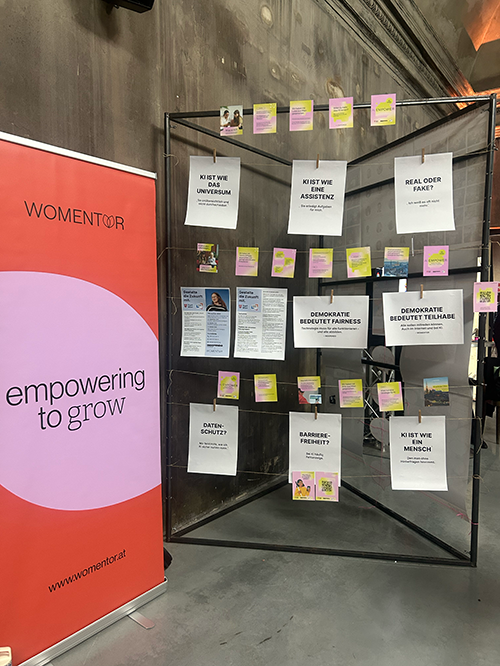
From the very first conversations, one thing became clear: people experience AI in very different ways. Some saw AI as supportive, others as unpredictable or difficult to assess. Many expressed both curiosity and concern. Comments included:
“AI feels like assistance, but only if it is well explained.”
“AI is like the universe, vast, complicated and hard to understand.”
“I need clear guidance on how to recognise when something is AI-generated.”
“I want to make sure my data is not used against me.”
“The most important thing is that AI can be adjusted to my needs.”
These reflections echo what international research has shown for years: meaningful digital participation does not begin with the technology, it begins with understanding.
AI as a democratic question, not just a technical one
AI is not neutral. It reflects the assumptions, blind spots and decisions of the people and systems that build it. It determines what information becomes visible, how decisions are made, and who can navigate the digital world with confidence.
A democracy that does not include the voices of people with disabilities, women, migrant communities or other underrepresented groups in the development of AI does more than overlook them.
It reproduces existing biases, creates new distortions and leads to decisions that are simply not fair.
Those who are missing in the data and design processes are misrepresented, or not represented at all, with real consequences for participation and opportunity.
Or, as one of our partner analyses notes:
“A democracy that ignores gender in AI builds its own blind spots.”
These blind spots do not stop at gender.
They affect people with disabilities, linguistic minorities, older people, migrants, young people, and anyone with limited access to digital education.
Inclusive AI is therefore not a niche topic, it is a prerequisite for distributing democratic power fairly in the digital age.
What people need to participate safely and confidently in AI
Across all conversations, four requirements emerged clearly:
1. Accessible explanations and simple language
People need understandable information before they can ask questions, reflect or engage critically with AI.
2. Orientation in distinguishing real from artificial content
Many participants had already encountered situations where AI-generated images or texts were confusing or misleading.
3. Accessibility as a design principle, not an afterthought
Screen reader compatibility, clear navigation, adjustable interfaces, sign language support and multiple communication formats are essential.
4. Real involvement in development processes
People want AI to reflect their lived realities.
This requires participation from the start, not as a correction applied later.
These needs mirror findings from our work with FLINTA* communities, migrant groups and young people: inclusive access to AI is ultimately a matter of representation, power and democratic rights.
From participants to co-creators: content from the community
A central outcome of the project is the content created together with the participants:
interviews, personal reflections, short statements, visual posts and clear messages about what inclusive AI should look like.
These pieces will be presented on the AI EMPOWER platform and across social media, not only to raise awareness, but to ensure that the perspectives of people with disabilities remain visible in Vienna’s digital future.
This marks a shift: the people who are usually spoken about become those who speak for themselves.
What the project enabled, and what follows next
Shaping the Future showed that people with disabilities have strong, well-founded ideas about how AI can become more inclusive, and they are ready to actively contribute.
The project created:
accessible spaces for learning, discussion and exploration
practical insights into barriers and opportunities
clarity on what kind of learning formats people actually need
content created by and for the community
a foundation for deeper, long-term participation in AI projects
Building on these results, the next steps include:
accessible learning materials on AI
a course on how to recognise AI-generated content
content in simple language
continued collaboration with Independo
further participation opportunities on the AI EMPOWER platform
The AI we build today decides whose voices will be heard tomorrow.
With this project, Vienna has demonstrated that building an inclusive digital future is possible, but only when people are invited not just to use technology, but to shape it.
Want to learn more?
This article was created as part of the project “Zukunft mitgestalten” (Shaping the Future Together).
The project is funded by the City of Vienna within the program European Capital of Democracy. Together with people with disabilities, we explored AI and co-created content to help make artificial intelligence more accessible for everyone.
Learn more about the project here: www.ai-empower.org/zukunft-mitgestalten
And become part of our digital community:: ai-empower.org/login

The project was developed in cooperation with Independo.
Supported by the City of Vienna
as part of the European Capital of Democracy

